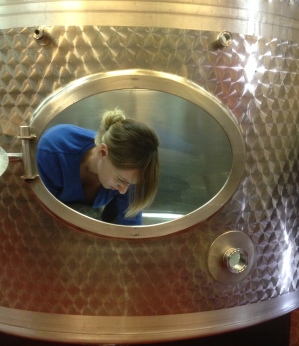
 If the complicated world of wine, with its weirdly-named varietals and strange descriptions — like, how can wine be dry? or have a nose? — has ever mystified you, consider the photo at left. That’s what I saw the first time I ventured into the building where the wine is made at Bluemont Vineyard.
A woman in a submarine?
No. That’s the cellar assistant, Lindsey Aymond, and she’s just crawled through that portal into one of the Vineyard’s stainless steel tanks.
Uh-oh. Is she going to get in trouble for that?
No. She does it all the time.
It turns out that after all the wine has been pumped out through the small port to Lindsey’s left, the tank has to be scrubbed with brewer’s cleanser, like every square inch of its surface, and then it has to be sanitized with ozone dissolved in water.
Wow. Can’t you just spray it with ozone, since that kills everything?
No. Wine leaves an acidic film on the wall of the tank, and sometimes the film contains bacteria, which might ruin the next batch that goes into the tank, so every time a tank is drained, Lindsey climbs through that portal and scrubs every inch, wearing special anti-acid boots and gloves.
Evidently the world of wine is even more complicated than I thought — which is a little daunting, since I’m there to learn about the wine-making process. So I’ve decided to streamline the initial phase of my education by focusing on something familiar:

Our friend Alex brought us a bottle of albariño from Galicia years ago, and we’ve been saving it for the specialest occasion we can think of, so my ignorance about that varietal is off-set by the comfort of seeing that name in my kitchen every day and expecting it to crown a celebration.
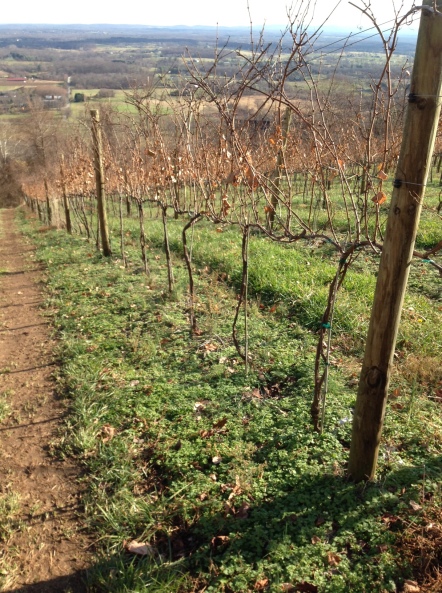 Bluemont Vineyard has two different sections of albariño. Both are on the north eastern edge of the property. Their orientation toward the sun is the same, and the difference in elevation can’t be more than 50 feet, but Jennifer Shailor, the vineyard’s chief winemaker, would like to keep those two wines separate from each other.
“This year we didn’t get enough volume to justify handling them separately,” she said, “so they’re both in the same tank, but their flavors are distinctly different, so in the future when we get better yields, we’ll bottle them separately.”
Albariño comes from Galicia, a province in northern Spain which is often compared to Ireland in climate and culture — cool, moist, green, hilly, and steeped in Celtic mysticism. In their natural form, albariño vines are vulnerable to a parasite that lives in American soils, so our albariños are grafted onto native American rootstock.
From the vine to the glass, this wine goes through ten steps. It’s picked, crushed, de-stemmed, and pressed all in one day. From the press, it’s pumped into a stainless steel 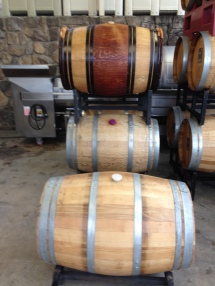 tank like the one Lindsay was cleaning, where it’s chilled to 40 degrees and left to settle for 24 hours. Once the first layer of solids settles out, the wine is racked — that is, the clean wine is pumped off those solids, which are known as the lees, into another tank. “At this point, we’re not aging albariño in barrels,” Jennifer says, “though we might try that in the future when there’s more.”
After the first racking, the wine is inoculated with the yeast mixture that will ferment it, and it’s left in that second tank for several weeks, until all the sugar is consumed. At that point the wine is racked off that sediment to another tank for heat stabilization, which is a way of ensuring that the wine won’t turn hazy if it happens to get warm in the bottle. That’s done by adding a bentonite slurry to the tank. Bentonite is a clay made mostly of calcium, and when you pour it in it looks like your wine is wrecked, so you are required to be brave.
According to the Winemaker’s Academy, this is how it works: “When hydrated in water, the minerals in bentonite become negatively charged. The negative ions in the clay bond with positively charged particles floating around in your wine and causing haziness. Generally wines are cloudy because the floating particles are all similarly charged (all positive or all negative). Similarly charged particles don’t settle out because they resist each other like magnets of the same polarity. They need something with an opposite charge to bond with them so they’ll be neutral. Because bentonite is negatively charged and dense, when it does bond with a positively charged particle they both sink. Once the bentonite is on the bottom, you can rack your clear wine off of the sediment.”
“After the bentonite rains through the wine,” Jennifer says, “we’ll chill the tank back to 40 degrees and let the wine cold-stabilize for a week or so. Then it’s racked again to a tank where it stays until it’s filtered and bottled.”
 That last step, the bottling, took place a week before the Great
  Blizzard of 2016 buried our albariño completely. They don’t get this kind of snow in Galicia.
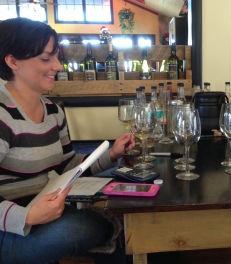
Until it melts, I guess we’ll stay inside and taste some wine.